
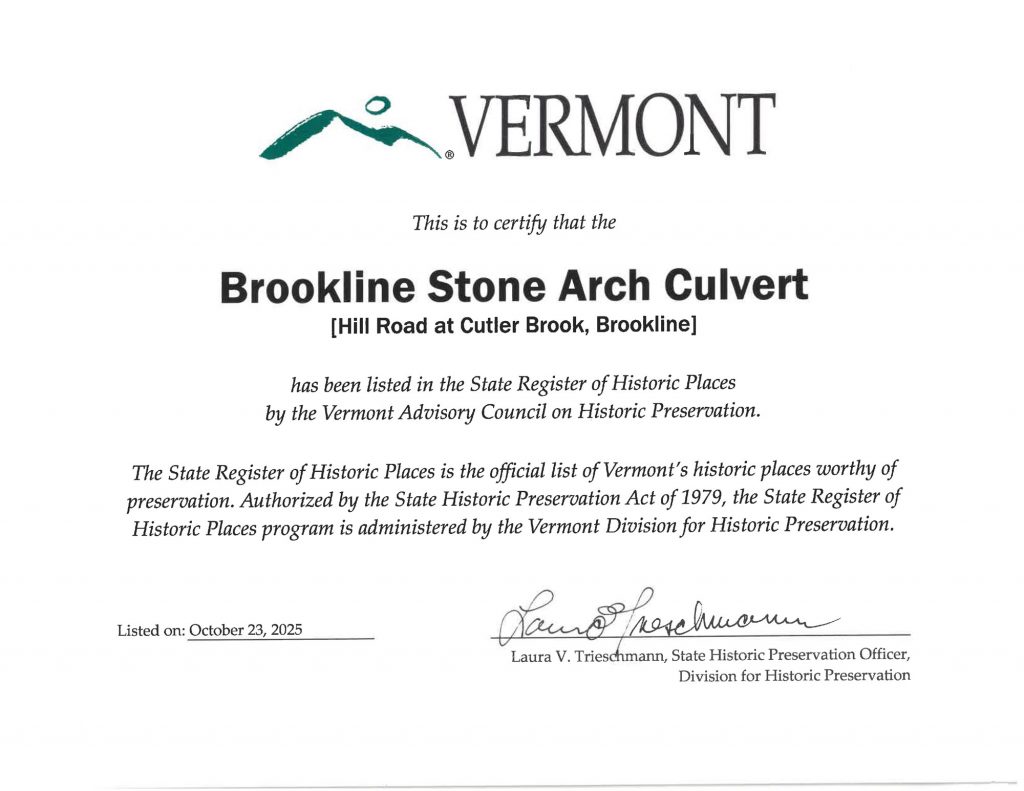
On October 23, 2025, the Vermont Advisory Council on Historic Preservation voted to list the Brookline Stone Arch Culvert in the State Register of Historic Places, the state’s official list of historic properties significant to the history of Vermont.
Location:
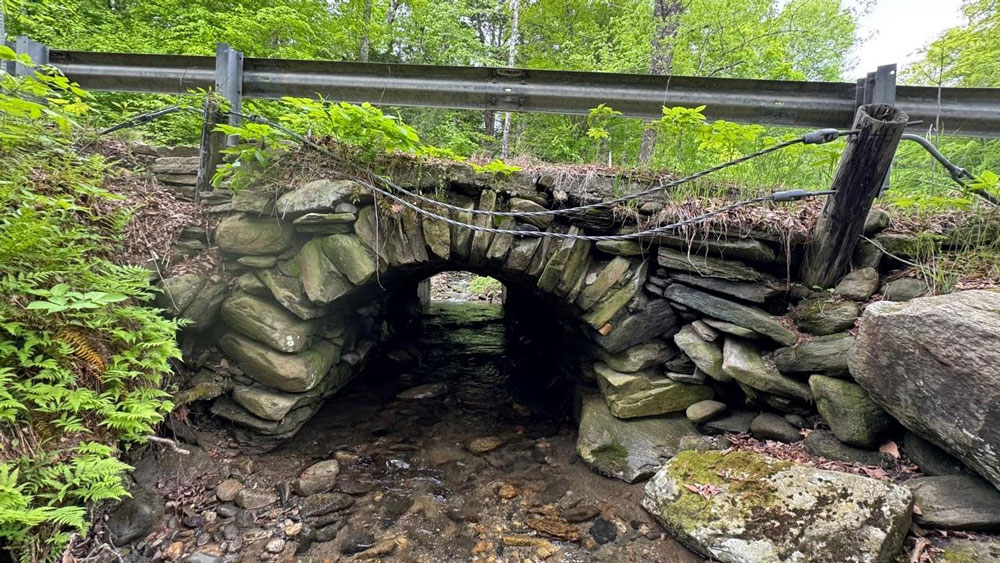
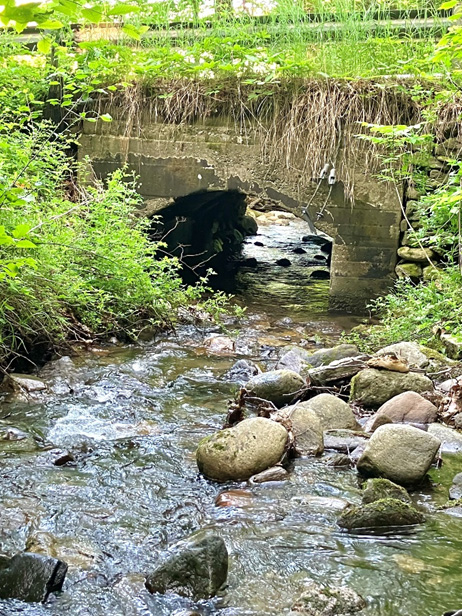
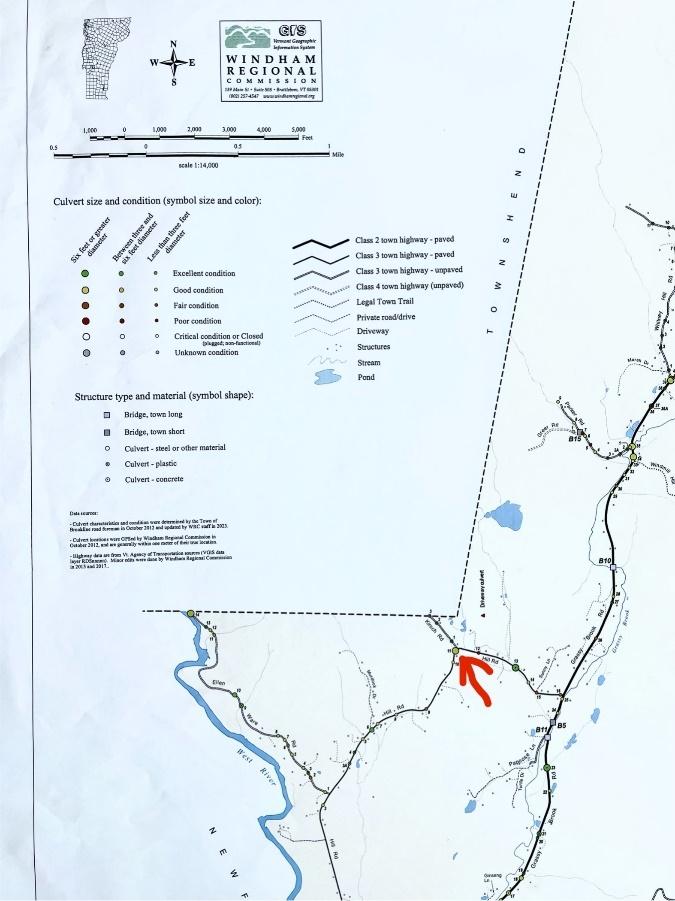
The Stone Arch Culvert is located on Hill Road over the Cutler Brook, Brookline, Vermont
Lat/Long: 43.015725, -72.621211
Stone Culvert Characteristics:
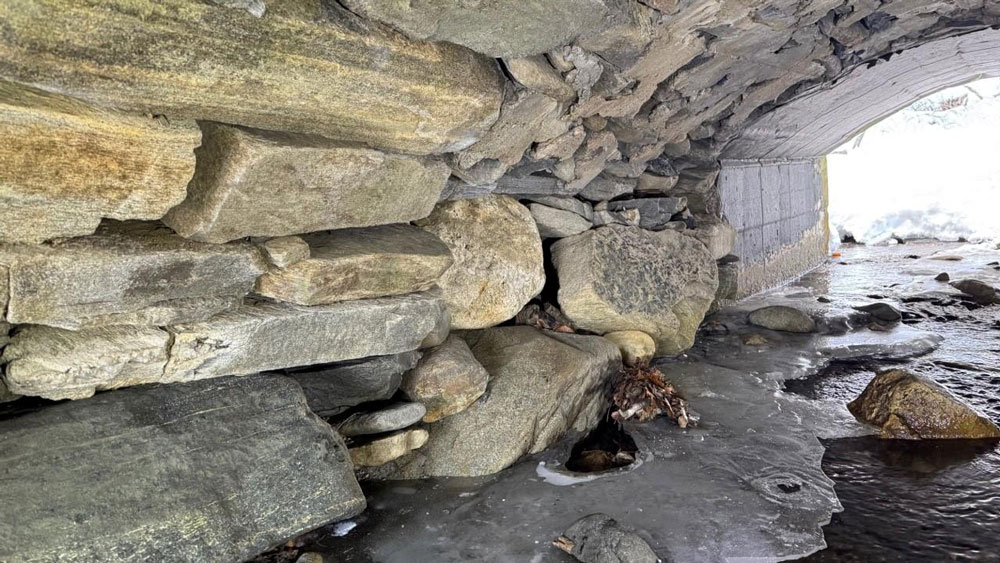
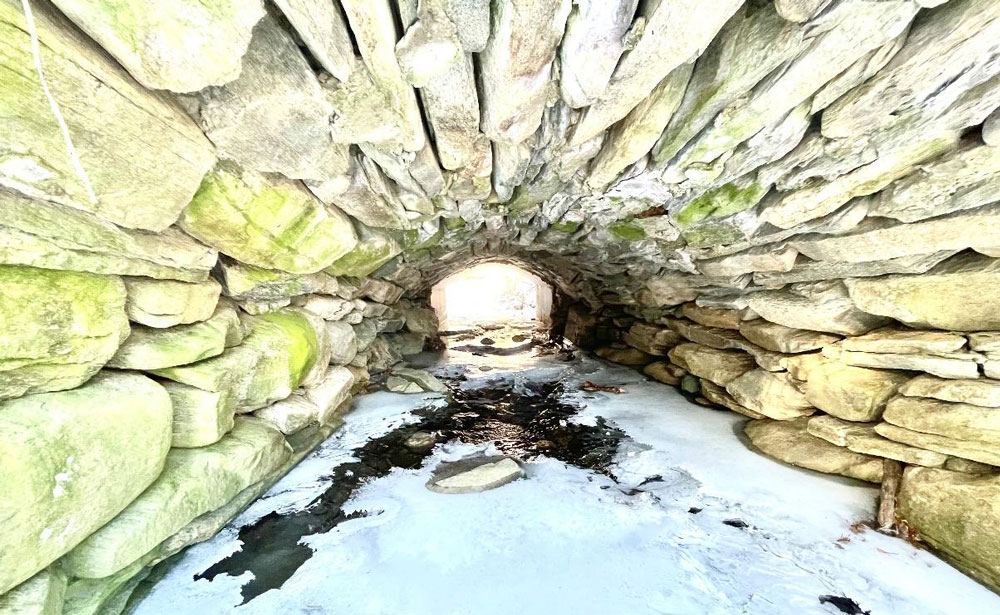
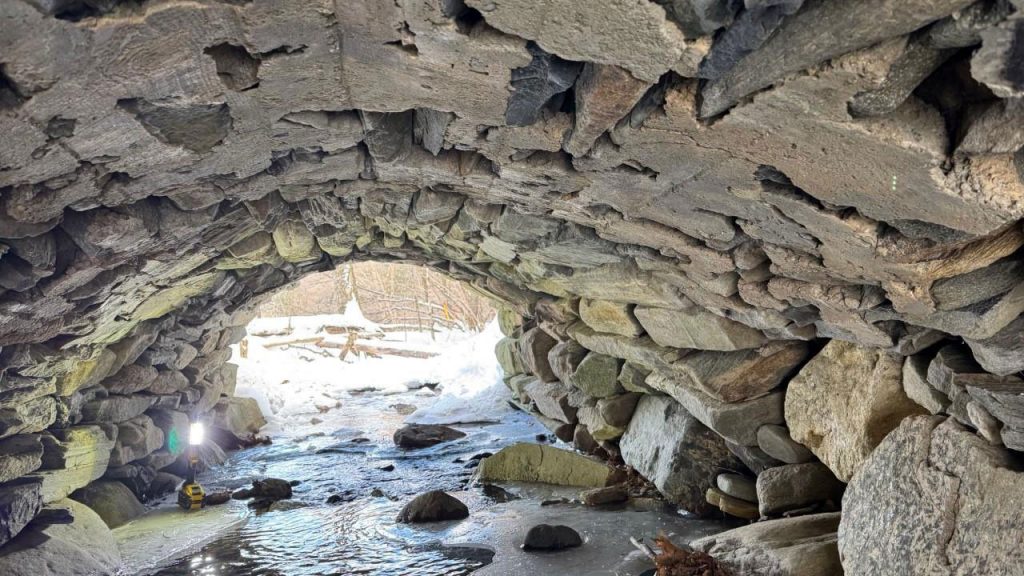
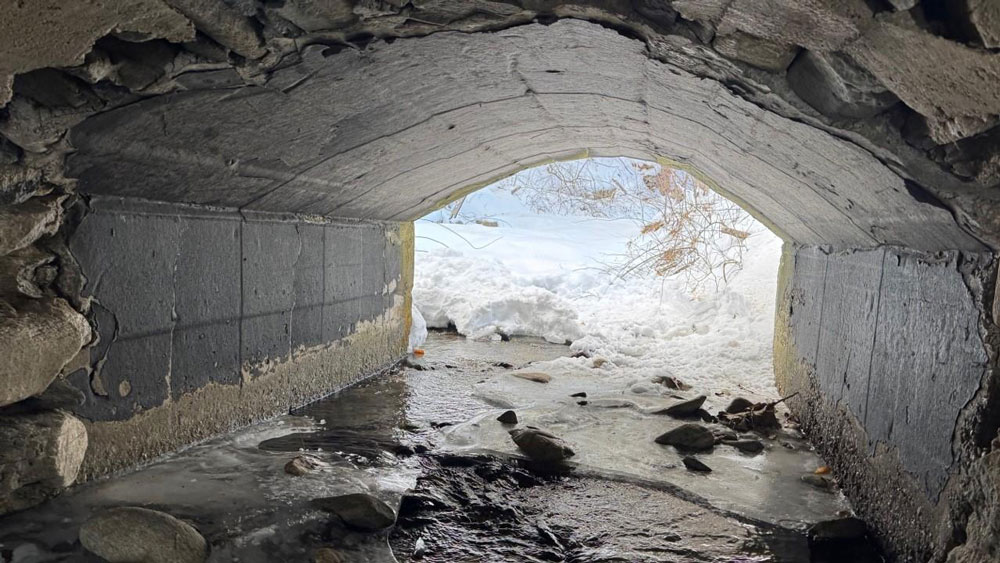
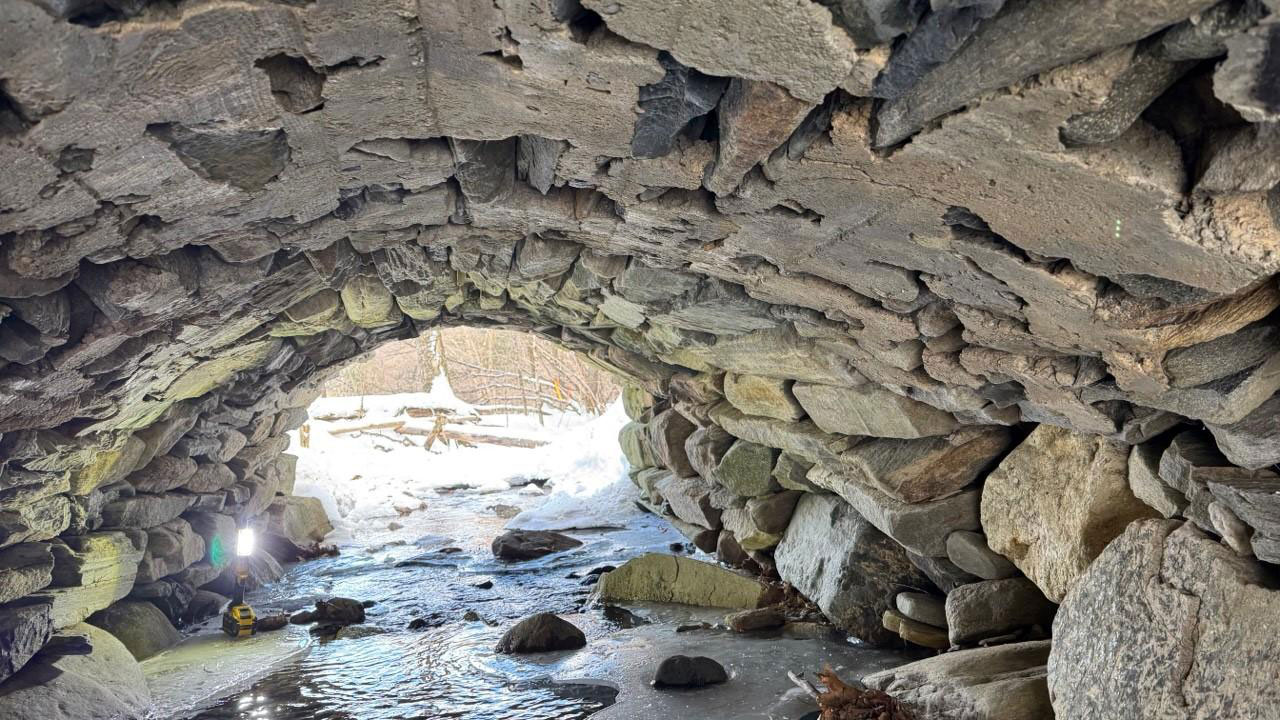
The Brookline Stone Arch bridge is a segmental arch stone and concrete culvert constructed in 3 sections with large boulder wingwalls. The c. 1901 14’ section is on the downstream side. Moving upstream is a narrow stone and concrete expansion and then on the upstream side is a c.1960 concrete culvert. A basic visual assessment of the bridge was performed by stone mason Brian Post on Feb 7th 2025 and again on May 17th 2025. Based on these assessments the downstream section was the original bridge and each subsequent section widened the bridge upstream. The following description consists principally of text from his Brookline Stone Arch Bridge Revised Assessment Report with supplementary descriptions.
1). The downstream section
This section is 14 ft long. The stonework was well built and it appears that an early Portland mortar, or a Portland/lime mix was used. This section demonstrates a building style that is typical of the work done by James Otis Follett on other bridges he built in Southern VT. The split stone arch voussoirs are fully intact on the downstream face and what is visible of the underside of the voussoirs on the upstream side, obscured by the addition, also shows an intact and well-constructed arch. On the southern side there are in fact large slabs of stone which extend outward from under the springers (bottom of stones of the arch). These large slabs form both a foundation for the bridge and also the bottom of the stream channel on that side. This effectively prevents the foundation from being undercut by erosion. The north side appears reasonably unmoved and stable. A few stones have cracked but this does not appear to affect the stability. Overall there does not appear to be much in the way of loose or missing stones or stones falling through the top of the arch. The vast majority of mortar in the lower joints is gone so minor amounts of water can flow between the stones, however the gaps are narrow and it does not appear to be causing any damage. It appears the stones were well stacked and that there are additional rocks behind the front ones which have and will continue to prevent erosion.
2). The middle section
This section appears to be an add on abutting the first section to increase the width of the bridge. It was built with stone and mortar or concrete on top of a board formed arch, traces of which are still evident in the impressions in the concrete on the underside of the stones. It was poorly constructed and relied on the mortar and concrete to “glue” it together. Despite being relatively poorly constructed, the north side appears reasonably unmoved and stable. The south side of this section is near to collapsing, a large poorly placed stone at the bottom of the arch has been pushed forward out of the wall. It is precariously balanced on other stones and is holding up the arch above. Nearly all the mortar on this section has fallen out of the wall.
3). The concrete section
This section is a further addition to widen the road to its present width. It is a monolithic cast in place concrete arch. The concrete appears to be in good sound condition. The bottom of the concrete was poured just at the level of the stream bed. It is possible that a stone foundation was built below the concrete, or that the stream bed was naturally rocky enough to achieve the same result.
See “Vermont Stone Culvert Inventory” for Site Characteristics and Survey Information
History:
The Brookline Stone Arch Bridge holds primary significance for being the work of an intuitive engineer, a farmer, Civil War veteran and mason from nearby Townshend, Vermont named James Otis Follett. The field stone arch to carry Hill Rd. across Cutler Brook and Follett’s body of stone work is atypical among rural secondary road bridges in Vermont, especially for having been built at the turn of the twentieth century when iron and steel had almost completely displaced wood and stone in bridge construction. The Brookline Stone Arch Bridge is located near the “Follett Stone Arch Bridge Historic District”, consisting of four bridges located in Townshend. Together with five other extant stone arch bridges built by Follett in Townshend and nearby Putney, they constitute probably the largest group of such related structures in the state.
The current Brookline Stone Arch bridge may have replaced an earlier stone culvert over the Cutler Brook at or near this location. In 1832 the Treasure’s Disbursement Journal includes payments to the Cutler family for bridge work and bridge order. Town Selectboard Minutes from 1893 include references to a stone bridge/culvert over the Cutler Brook in relation to a petition, and then construction updates, to alter the course of Hill Road south of Cutler Brook.
The earliest section of the current bridge is constructed with stacking methods and construction details, including the mortar application, that are consistent with Follett’s other known nearby bridge work. From visual inspection the mortar appears to be a Portland cement mixture and was applied in the construction of the bridge. No indications are present that would suggest later application or repointing. The use of a Portland cement mortar mixture supports a turn of the century construction date. A formal mortar analysis could further verify the mortar composition and compare it to other more studied Follett bridges.
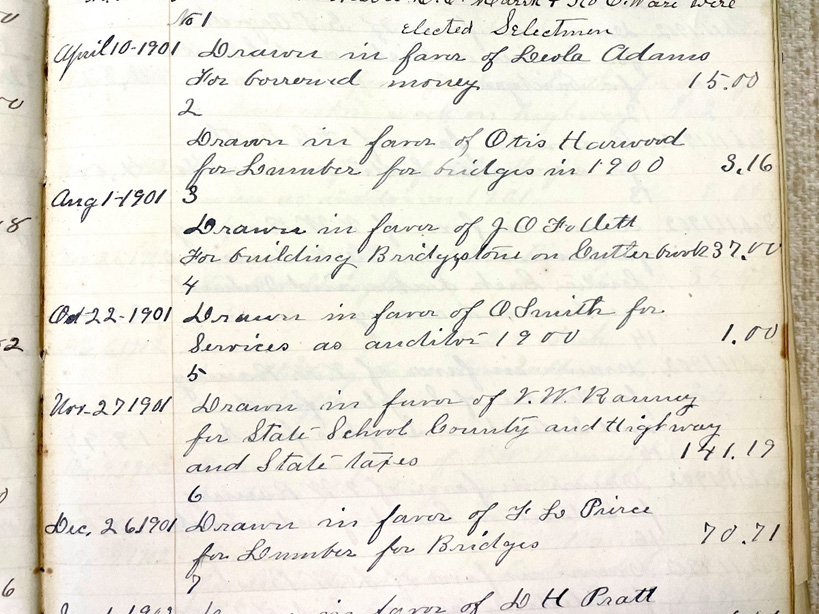
In addition to the construction methods linking this bridge to Follett there is a reference in the town’s Treasure’s Disbursement Journal for a payment to J.O. Follett in 1901 for “building bridge, stone on Cutler brook”.
James Otis Follett
Born in East Jamaica, Vermont in 1843, James Otis Follett lived and worked most of his life on a farm in Townshend. His farm was up the road from the Charles A. Cutler farm in Brookline, Vermont. Follett and Cutler both served in the Civil War during 1862-1863. Follett served with Company D of the 16th Volunteer Regiment in 1862, fought in the Battle of Gettysburg, and returned to Vermont in 1863 as an Army corporal. His neighbor Charles A. Cutler served with Company H of the 8th Vermont Volunteer Regiment in 1862-1863. How well these two men knew each other is speculative, but the fact that they farmed the hillsides of neighboring towns during the same period, both served in the Civil War, and that Follett was paid for the bridge work over Cutler Brook make a personal relationship likely.
Among other public activities, Follett served Townshend for several years as road commissioner, being responsible for the maintenance and improvement of its public highways. During the 1890’s, when Follett was in his fifties, he seems to have shifted his vocational emphasis from farming to masonry. The first known entry of payment to Follett for the construction of a “stone bridge” appears in the Townshend town records in 1894. Thereafter, Follett built one or two bridges almost every year until his death in 1911, creating substantial yet inexpensive structures to meet the needs of at least three small rural towns. Additionally, he constructed foundations for buildings and abutments for wood covered bridges, including in 1900 a center pier for the famous Holland Bridge (demolished in 1952) across the West River in Townshend.
The total number of bridges built by James Otis Follett is not known definitely. A grandson, Robert Follett of Ascutney, Vermont, estimates that he may have built about forty bridges. Entries in the Putney and Townshend records list payments to Follett for a total of about twenty bridges and culverts built on public highways in those two towns.
Although Follett lacked formal training in engineering, apparently he did consult a popular engineering text of the period, A Treatise on Masonry Construction by Ira Osborn Baker. A copy of the ninth edition, published in 1899 and apparently used by Follett, remains in the possession of the Follett family. The book describes methods of constructing stone arch bridges; however it is not known to what extent Follett actually depended on the book in his work, for he built at least four bridges in Townshend prior to the publication of his copy of the Baker text.
Whatever the source of his skill, Follett succeeded in building durable and handsomely crafted bridges. Some of them now carry truckloads which Follett could not have imagined, yet it has not been necessary to alter or reinforce them significantly. Complementing their structural integrity, the Follett bridges possess distinctive aesthetic qualities in their individual variations of the arch form and stone material.
Currently the greatest general threat to the surviving Follett bridges is inadequate maintenance, both of the active and disused ones. Follett bridges often are in inconspicuous locations on back roads, which tends to keep them from becoming more widely known and appreciated by the public.
The c.1901 Brookline Stone Arch bridge has survived in part due to Follet’s masterful construction and to the Town’s repeated decision to retain the bridge when demands on the road increased. The date of the center stone section is not known but given its poor construction, mainly the reliance on the mortar/concrete to “glue” it together, it was not constructed by a master stone mason. It is possible that the center section was constructed in the 1920s or 1930s as increased automobile traffic was a common reason to expand road widths. And then again about another 30 years later c.1960 the town constructed the concrete section to expand the full structure to 28’.
Harlan Allbee
Harlan Allbee was the Brookline Road Commissioner at the time of the concrete addition. Allbee was born and raised in Brookline and lived there all his life. He had a farm and wood mill across the street from the stone arch bridge and always said the stone bridge was built by James O. Follett. When again the road needed to be wider Allbee pushed the state to keep the stone arch bridge, because it was built to Follett’s exacting standards, and, in his view would last longer than anything they might replace it with. Apparently, Allbee’s view carried and that is when the concrete arch extension was added to the upstream end. Because of this act of determination by Harlan Allbee, and the exceptional skill of its builder, the stone arch bridge in Brookline, VT still exists today.
Taken together, the surviving bridges constructed by James Otis Follett constitute a highly representative and intact record of the work of an extraordinary native builder. The Brookline stone arch bridge, as well as all of Follett’s bridges are significant and deserve public recognition and careful preservation to ensure the continued survival of this unique legacy from late nineteenth and early twentieth century rural Vermont.
References/citations:
- Derry, Anne. James Otis Follette (sic), Bridgebuilder. Unpublished manuscript prepared for Graduate Program in Restoration and Preservation of Historic Architecture, Columbia University, New York, New York, 1975.
- Notes from interview of Robert Follett, Ascutney, Vermont by Michele Fromme on 9 July 1976.
- Freeman, Castle. A Stitch in Time: Townshend Vermont 1753-2003. 1st ed., Townshend Historical Society, Inc., 2003.
- Nichols, G.W., and W.E. Rather, publishers. “Death of Deacon James O. Follett.” Vermont Phoenix, February 1911. Zeller Scrapbook, Townshend Public Library.
- Notes from Roger Allbee Townshend, Vermont on June 3, 2025.
- Notes from Brookline Stone Arch Bridge Revised Assessment Report and Repair Guide, Brian Post, Owner of Standing Stone LLC, May 17, 2025.
- Book of Records from Town of Brookline, Vermont 2025.
- Photos courtesy of Daniel Towler of Brookline, Vermont 2025.
- Photos courtesy of Alyssa Schmidt of Brookline, Vermont 2025.
- Photos courtesy of Brian Post, stone masonry consultant, 2025.
- Photos courtesy of Heidi Clawson of West Townshend, Vermont 2017.
- Townshend Historical Society, www.townshendvt.org.